
Do you know that you don’t know?

“True expert knowledge in life and investing does not exist, only varying degrees of ignorance.”

Gautam Baid

Arrogance means having strong headwind ahead: being arrogant means to close our minds to alternative ways of seeing the world, while being humble means to be open to new ideas and visions.

Why?

Because nobody has such an extensive knowledge that allows to discart any new input, not even on a single specific niche of the knowledgeable universe. This is due to the fact that knowledge is immense: even if we master a specific area of knowledge (for example: equity investing or bioinformatics) we know that there are some topics within this area that we do not know; in addition there are possibly topics that we do not know that exist and they may represent a relevant piece of the knowledgeable universe!
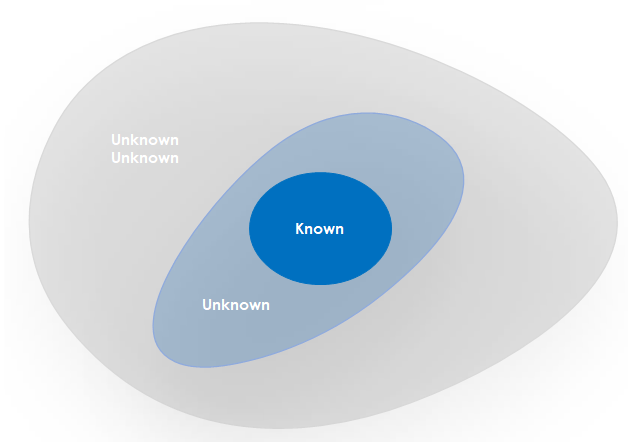

In summary we should always be aware that, out of a certain knowledge universe:

  • We know something (KNOWN)
  • We know that there is something that we do not know (UNKNOWN)
  • There is a last area of knowledge that we are not aware of (UNKNOWN UNKNOWN), which could likely cover most of the knowledge universe!

Being aware about our limitations may be a very powerful way of counteract the Dunning-Kruger effect, which is a cognitive bias whereby people with low expertise and knowledge regarding a specific universe of knowledge overestimate their knowledge.

Having in mind this, we can act being humble in front of new pieces of information and new opinions that come from other people.
Being open minded and accepting that the person in front of us may be right even if in contrast with our beliefs and knowledge is a great cognitive advantage.

Therefore be humble, not arrogant.

Your brain can fool you

“We recognized early on that very smart people do very dumb things, and we wanted to know why and who, so that we could avoid them.”

Charlie Munger

Our brain is not made to guide us in the information world. It has basically not evolved in the last thousands years, and so cannot lead us to optimal decisions in the world we live in. We still act and react like hunters in the savana, which is what our predecessors had to do time ago.

Now, unlike our predecessors, our daily routine doesn’t bring us to look for preys in order to have a dinner. It is enough to enter a supermarket to do that.
Unlike our predecessors, our daily routine is full of informative stimuli: social networks messages, advertising, job or school assignments just to name a few.
But our brain is not prepared for these continuous stimuli, and – in spite of acting with rationality – our mind very often leads us to suboptimal decisions caused by different behavioural biases.

This happens also in investing.

How many times have you bought a stock at its price peak, just to see it begin a terrific downward spiral shortly afterwards?
It happened to me several times. That was because I trusted an advise coming from a famous and trustable source (authority bias), because I made superficial analysis mostly from sources supporting my preexisting view (confirmation bias) or simply because all the market and all the news were describing that stock as the hottest (consensus bias).

Can we modify our brain, in order to avoid misjudgements?

NO.

But we can train our brain to reduce the impact of such biases.
It is enough to study, understand and interiorize them in order to improve our decision-making process.
Each time that we face an investment decision, we should just ask to ourselves: am I taking a rational decision, or may I be fooled by some of these biases?

As I consider behavioral finance the best edge that an investor can have, I will try to go deeper in the topic in the future. With this perspective, a wonderful summary of the main biases is provided by Charlie Munger in his famous speech on the Standard Causes of Human Misjudgment.