
I bought my bank’s mutual funds. Is that ok?

“If you don’t like the idea that most of the money spent on lottery tickets supports government programs, you should know that most of the earnings from mutual funds support investment advisors’ and mutual fund managers’ retirement.”

Robert Kiyosaki

I began to track the performance of my bank’s mutual funds in 2016.
Since then, this is the yearly return they gave to me: +0.2% per year.
Yes, correct: zero, nix, nada, null !
During the same period, the S&P500 doubled. More or the same happened to the MSCI World.

Am I an unlucky case?

No, I am not. Mutual funds that beat the market average performance over relevant periods of time are rare. Additionally, for funds distributed by banks in particular, it is even more difficult to get better-than-average results:

  • bank (and insurance) affiliated funds have high costs: usually they have a 2-3% cost per year, which means that the gross return should overperform the market benchmark by at least 2-3% in order to reach a better-than-average net performance. Do you think that it is easy for a fund manager to do that?
  • fund managers are usually judged over quarterly performance, for funds that are often set to have a duration of 5 years. Do you think that is possible to obtain long term results, with this kind of short-term focus?

There are other factors to be taken into consideration, but costs and short term focus are already enough to make you understand why it is really rare to obtain good perfomance from banks and insurances affiliated funds.

What are the best alternatives?

  • If you do not want to invest your personal time in investment activity, you may look for independent mutual funds. In this case, you should ask for long term past good performance and ensure that the fund manager has “skin in the game”, that means that has personally invested in the same fund you would buy: just applying these 2 criteria you will discover that most of the available options have to be excluded. Oh, I forgot: check also the manager fee structure and ensure that is mostly performance-based!
  • Otherwise, you may follow the advice of Warren Buffett to his wife: “put 10% of the cash in short-term government bonds and 90% in a very low-cost S&P 500 index fund”. Just have a look to past performance – you will be surprised to see how this simple policy beat most of professionals’ results.
  • Also, you may rely on an independent financial consultant.

So, in conclusion: is Robert Kiyosaki right when he says that “most of the earnings from mutual funds support investment advisors’ and mutual fund managers’ retirement”?
Probably yes, at least in many cases. Just check that it is not your case.

Do you know that you don’t know?

“True expert knowledge in life and investing does not exist, only varying degrees of ignorance.”

Gautam Baid

Arrogance means having strong headwind ahead: being arrogant means to close our minds to alternative ways of seeing the world, while being humble means to be open to new ideas and visions.

Why?

Because nobody has such an extensive knowledge that allows to discart any new input, not even on a single specific niche of the knowledgeable universe. This is due to the fact that knowledge is immense: even if we master a specific area of knowledge (for example: equity investing or bioinformatics) we know that there are some topics within this area that we do not know; in addition there are possibly topics that we do not know that exist and they may represent a relevant piece of the knowledgeable universe!


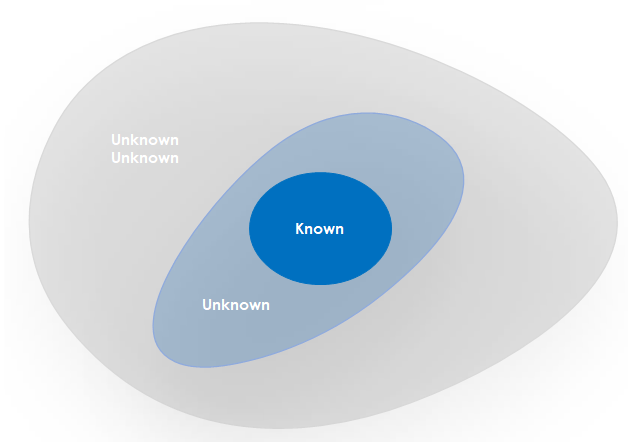
In summary we should always be aware that, out of a certain knowledge universe:

  • We know something (KNOWN)
  • We know that there is something that we do not know (UNKNOWN)
  • There is a last area of knowledge that we are not aware of (UNKNOWN UNKNOWN), which could likely cover most of the knowledge universe!

Being aware about our limitations may be a very powerful way of counteract the Dunning-Kruger effect, which is a cognitive bias whereby people with low expertise and knowledge regarding a specific universe of knowledge overestimate their knowledge.

Having in mind this, we can act being humble in front of new pieces of information and new opinions that come from other people.
Being open minded and accepting that the person in front of us may be right even if in contrast with our beliefs and knowledge is a great cognitive advantage.

Therefore be humble, not arrogant.

No, you don’t need a high IQ to be a successful investor

“A lot of people with high IQs are terrible investors because they’ve got terrible temperaments.”

Charlie Munger

Do you know your intelligence quotient (IQ)?
If you are curious and you want to measure it, just go to the Mensa website and take the test. I did it, it is a challenging experience.

Did you take it?
Are you in the best 2% percentile? Or in the best 5%?
Now please listen: it doesn’t matter!
YOUR IQ IS NOT IMPORTANT TO ACHIEVE SUCCESSFUL RESULTS IN INVESTING. At least, it is not important to be at the top of the IQ ranking.

It is a common mistake to assume that high-IQ people take the best investment decisions. The point is that good investments depend on the right “temperament”, not on a high IQ – which in some cases may even become detrimental, due to behavioral biases.

According to Wikipedia, temperament broadly refers to consistent individual differences in behavior that are biologically based and are relatively independent of learning, system of values and attitudes. But this definition is not useful for the specific topic of investments.
I found the book of William Green “Richer Wiser Happier” a wonderful source of examples of successful temperament, as he describes the distinctive traits of some of the world’s greatest investors – all of them being learning machines and nontribal freethinkers.
Just to give you a short idea of some of these traits as described in the book:

  • Mohnish Pabrai: cloning others’ best ideas
  • Sir John Templeton: a self-disciplined, nontribal investor
  • Nick Sleep and Qais Zakaria: focus on “destination analysis”, not on short term
  • Tom Gayner: adopting “directionally correct” habits
  • Charlie Munger: avoiding standard stupidities

As you can understand, these are all temperament competitive advantages, not IQ advantages.

Do you need to match 100% the temperament profiles of these investment masters?
No, you do not need to. But you should learn from them and selectively adopt specific habits or methods: you do not need to become like them, but you can improve yourself during your life and become the best version of yourself.

Are you going to follow my advice? Then, have a nice life journey!

Buy it for the long run

“If you aren’t willing to own a stock for 10 years, don’t even think about owning it for 10 minutes.”

Warren Buffett

Have you ever bought a hot stock, planning to sell it in a short time with a significant gain?

Do not lie. You did it.

When we listen to financial news or when we get a suggestion from a friend who is an expert, it is quite normal to get excited about a stock. Very often, our mind pushes us to action and we buy.
And in many cases the price of that stock begins to drop.

No, you are not unlucky. That’s normal.

A hot stock is often bought in the very wrong moment: after a nice good price run. That’s the moment in which our brain fools us, because it projects in the future the same recent positive trend.

What can we do to avoid that?
Just take a seat, grab a cup of coffee and try to be rational.
First of all, you have to be aware that there is a very high probability that the stock price will fall after you buy it – I am not aware of any worldclass investor who was able to buy stocks exactly at a price minimum point, so how can you be better?
Your best approach is to really avoid any “hot suggestion” and do your homework, which is to analyse any interesting stock by understanding the underlying business and its potential value, to see if it is cheap enough to buy or not. Value vs price, remember?
If you then decide to buy, then do it for the long run. Are you willing to keep that stock in your portfolio for the next 10 years?
To reinforce the quality of your decision you should also think of a no-sale rule and stick to it; my proposal is that when you buy a stock you should oblige yourself to avoid selling it at least for the next 2 years (unless the investment thesis changes, of course).

It sounds difficult, but it really helps.

Value vs Price

“Price is what you pay, value is what you get.”

Warren Buffett

Value and price are quite different things. Yet, value and price words are usually used as a synonymous, even by finance news writers.

Let’s try to understand the difference through an example.
Let’s imagine that you need a new smartphone, and you want a specific model of your beloved brand. You are hesitating, because the price is very high: after a brief check on online sites, you have realized that you should pay around 1000$.
Then Black Friday arrives and suddenly the price of that model drops to 600$ !

Did the value of the smartphone change?
NO.
The value of the the smartphone is always the same: same functions, same materials, same brand…. WHAT YOU GET is exactly the same

Did the price of the smartphone change?
YES.
The worth (or value) didn’t change, but the price decreased… WHAT YOU PAY has changed.

If you consider investing in stocks, things are pretty much the same: to GET a piece of ownership of a company which has a certain value you have to PAY a certain price.

To be a good value investor you have to behave like a business owner: you have to understand the company and you have to – after studying it – estimate its VALUE, and if you decide to make the investment then you buy a percentage interest in that business proportional to the number of share that you get.
To get a certain number of stock shares in a company, you have to pay a specific PRICE. For public companies, you pay when you buy from a stock exchange like the NYSE or the Nasdaq.

When you see all the crazy changing numbers ticking in red and green on your Yahoo Finance app or similar, you see the stock prices. Not the stock values. Do not confuse the 2 things.

Value investing consists in buying a stock when its price is (heavily) below its value. There are many implication of this; we will talk about the margin of safety and long-term impacts in another post.

Anyway, please remember: just looking at the price is not investing.

Why value investors do like stocks so much

“Auction-driven markets have this nuance where they either get euphoric or pessimistic, and they might do both in the same year. That’s what leads to distortions and mispricing, and that’s what we can take advantage of.”

Mohnish Pabrai

Value investing is usually focused on publicly traded stocks. There are a few reasons for this.

The asset class of public company stocks has historically outperformed other asset classes like bonds or commodities. The S&P 500 index (which tracks the stock price performance of the largest listed companies in the US) has in the average returned more than 10% per year in the last 50 years: we have already discussed about the power of long term compounding and so you can appreciate the importance of such a performance.

In addition to that, stock exchanges are auction-driven markets subject to boom-and-bust cycles. It means that these markets are subject to the impact of human psychology, and so stocks are often increasing in price during euphoric periods and heavily decreasing in price when pessimism is dominant. Just think of it as if a manic-depressive person called Mr Market would offer to sell you a stock for a very low price in a pessimistic day, while coming back to you the next day in an euphoric mood offering to buy from you the same stock of the previous day for a much higher price: this is the brilliant allegory used by Ben Graham, the “father” of value investing, to describe the irrationality of stock markets.

A good value investor is aware of the average long-term positive performance of publicly traded stocks and can obtain even better results than average, if able to use the irrationality of markets at his or her advantage in spite of surrendering to human cognitive biases.

Your brain can fool you

“We recognized early on that very smart people do very dumb things, and we wanted to know why and who, so that we could avoid them.”

Charlie Munger

Our brain is not made to guide us in the information world. It has basically not evolved in the last thousands years, and so cannot lead us to optimal decisions in the world we live in. We still act and react like hunters in the savana, which is what our predecessors had to do time ago.

Now, unlike our predecessors, our daily routine doesn’t bring us to look for preys in order to have a dinner. It is enough to enter a supermarket to do that.
Unlike our predecessors, our daily routine is full of informative stimuli: social networks messages, advertising, job or school assignments just to name a few.
But our brain is not prepared for these continuous stimuli, and – in spite of acting with rationality – our mind very often leads us to suboptimal decisions caused by different behavioural biases.

This happens also in investing.

How many times have you bought a stock at its price peak, just to see it begin a terrific downward spiral shortly afterwards?
It happened to me several times. That was because I trusted an advise coming from a famous and trustable source (authority bias), because I made superficial analysis mostly from sources supporting my preexisting view (confirmation bias) or simply because all the market and all the news were describing that stock as the hottest (consensus bias).

Can we modify our brain, in order to avoid misjudgements?

NO.

But we can train our brain to reduce the impact of such biases.
It is enough to study, understand and interiorize them in order to improve our decision-making process.
Each time that we face an investment decision, we should just ask to ourselves: am I taking a rational decision, or may I be fooled by some of these biases?

As I consider behavioral finance the best edge that an investor can have, I will try to go deeper in the topic in the future. With this perspective, a wonderful summary of the main biases is provided by Charlie Munger in his famous speech on the Standard Causes of Human Misjudgment.

Is it worth investing, according to Albert Einstein?

Compound interest is the eighth wonder of the world. He who understands it, earns it; he who doesn’t, pays it

Albert Einstein

Yes, it really seems that Albert Einstein was struck by the properties of compound interest.

Probably he was referring to the laws of physics; nevertheless we are interested in investments and so the meaning of compound interest can be easily understood thinking to the interest associated with an investment: the underlying amount of money increases exponentially—rather than linearly—over time.

What does it mean? It is very simple to show it with an example.

Let’s imagine that you are a college student in your 20s.
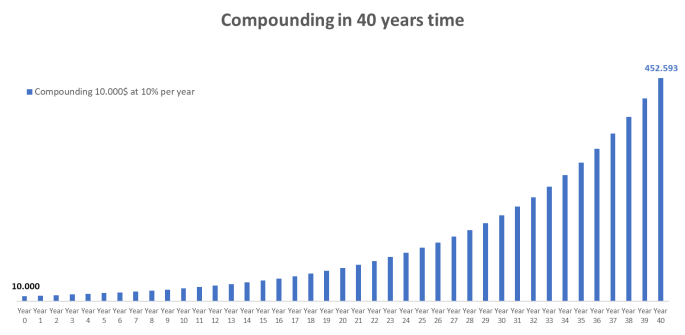
Then you may be interested to calculate the final value of a 10.000$ investment with a 10% return along the next 40 years.
By the time you are 60 how much will your investment be worth? The answer is easily provided by math: the initial amount has to be multiplicated by (1+10%)^40.

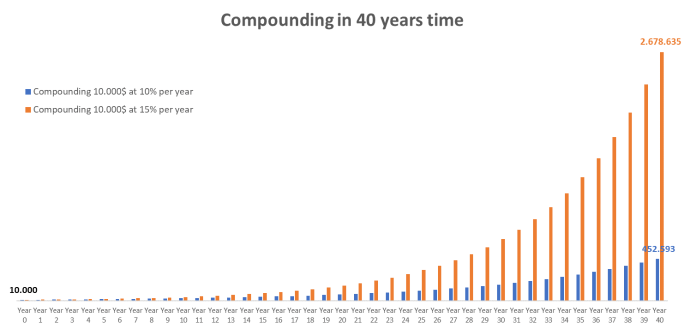
You can therefore easily calculate that the 10.000$ have become around 452.000$: that’s the power of compounding! The money has increased by a 45x factor.

If you are able to reach a higher percentage return, much better. Much much better.
If you can have your investment grow at 15% yearly instead of 10%, after 40 years you will see an increase of your money of about 268x times. Yes, the numbers are correct: if you allow 10.000$ to compound for 40 years at 15% then your investment will be worth 2.678.635$.

Now tell me: isn’t it worth investing well for your old age?