
Value vs Price

“Price is what you pay, value is what you get.”

Warren Buffett

Value and price are quite different things. Yet, value and price words are usually used as a synonymous, even by finance news writers.

Let’s try to understand the difference through an example.
Let’s imagine that you need a new smartphone, and you want a specific model of your beloved brand. You are hesitating, because the price is very high: after a brief check on online sites, you have realized that you should pay around 1000$.
Then Black Friday arrives and suddenly the price of that model drops to 600$ !

Did the value of the smartphone change?
NO.
The value of the the smartphone is always the same: same functions, same materials, same brand…. WHAT YOU GET is exactly the same

Did the price of the smartphone change?
YES.
The worth (or value) didn’t change, but the price decreased… WHAT YOU PAY has changed.

If you consider investing in stocks, things are pretty much the same: to GET a piece of ownership of a company which has a certain value you have to PAY a certain price.

To be a good value investor you have to behave like a business owner: you have to understand the company and you have to – after studying it – estimate its VALUE, and if you decide to make the investment then you buy a percentage interest in that business proportional to the number of share that you get.
To get a certain number of stock shares in a company, you have to pay a specific PRICE. For public companies, you pay when you buy from a stock exchange like the NYSE or the Nasdaq.

When you see all the crazy changing numbers ticking in red and green on your Yahoo Finance app or similar, you see the stock prices. Not the stock values. Do not confuse the 2 things.

Value investing consists in buying a stock when its price is (heavily) below its value. There are many implication of this; we will talk about the margin of safety and long-term impacts in another post.

Anyway, please remember: just looking at the price is not investing.

Why value investors do like stocks so much

“Auction-driven markets have this nuance where they either get euphoric or pessimistic, and they might do both in the same year. That’s what leads to distortions and mispricing, and that’s what we can take advantage of.”

Mohnish Pabrai

Value investing is usually focused on publicly traded stocks. There are a few reasons for this.

The asset class of public company stocks has historically outperformed other asset classes like bonds or commodities. The S&P 500 index (which tracks the stock price performance of the largest listed companies in the US) has in the average returned more than 10% per year in the last 50 years: we have already discussed about the power of long term compounding and so you can appreciate the importance of such a performance.

In addition to that, stock exchanges are auction-driven markets subject to boom-and-bust cycles. It means that these markets are subject to the impact of human psychology, and so stocks are often increasing in price during euphoric periods and heavily decreasing in price when pessimism is dominant. Just think of it as if a manic-depressive person called Mr Market would offer to sell you a stock for a very low price in a pessimistic day, while coming back to you the next day in an euphoric mood offering to buy from you the same stock of the previous day for a much higher price: this is the brilliant allegory used by Ben Graham, the “father” of value investing, to describe the irrationality of stock markets.

A good value investor is aware of the average long-term positive performance of publicly traded stocks and can obtain even better results than average, if able to use the irrationality of markets at his or her advantage in spite of surrendering to human cognitive biases.

Your brain can fool you

“We recognized early on that very smart people do very dumb things, and we wanted to know why and who, so that we could avoid them.”

Charlie Munger

Our brain is not made to guide us in the information world. It has basically not evolved in the last thousands years, and so cannot lead us to optimal decisions in the world we live in. We still act and react like hunters in the savana, which is what our predecessors had to do time ago.

Now, unlike our predecessors, our daily routine doesn’t bring us to look for preys in order to have a dinner. It is enough to enter a supermarket to do that.
Unlike our predecessors, our daily routine is full of informative stimuli: social networks messages, advertising, job or school assignments just to name a few.
But our brain is not prepared for these continuous stimuli, and – in spite of acting with rationality – our mind very often leads us to suboptimal decisions caused by different behavioural biases.

This happens also in investing.

How many times have you bought a stock at its price peak, just to see it begin a terrific downward spiral shortly afterwards?
It happened to me several times. That was because I trusted an advise coming from a famous and trustable source (authority bias), because I made superficial analysis mostly from sources supporting my preexisting view (confirmation bias) or simply because all the market and all the news were describing that stock as the hottest (consensus bias).

Can we modify our brain, in order to avoid misjudgements?

NO.

But we can train our brain to reduce the impact of such biases.
It is enough to study, understand and interiorize them in order to improve our decision-making process.
Each time that we face an investment decision, we should just ask to ourselves: am I taking a rational decision, or may I be fooled by some of these biases?

As I consider behavioral finance the best edge that an investor can have, I will try to go deeper in the topic in the future. With this perspective, a wonderful summary of the main biases is provided by Charlie Munger in his famous speech on the Standard Causes of Human Misjudgment.

Is it worth investing, according to Albert Einstein?

Compound interest is the eighth wonder of the world. He who understands it, earns it; he who doesn’t, pays it

Albert Einstein

Yes, it really seems that Albert Einstein was struck by the properties of compound interest.

Probably he was referring to the laws of physics; nevertheless we are interested in investments and so the meaning of compound interest can be easily understood thinking to the interest associated with an investment: the underlying amount of money increases exponentially—rather than linearly—over time.

What does it mean? It is very simple to show it with an example.

Let’s imagine that you are a college student in your 20s.
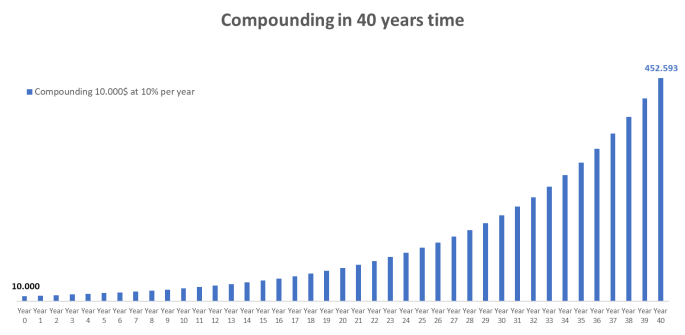
Then you may be interested to calculate the final value of a 10.000$ investment with a 10% return along the next 40 years.
By the time you are 60 how much will your investment be worth? The answer is easily provided by math: the initial amount has to be multiplicated by (1+10%)^40.

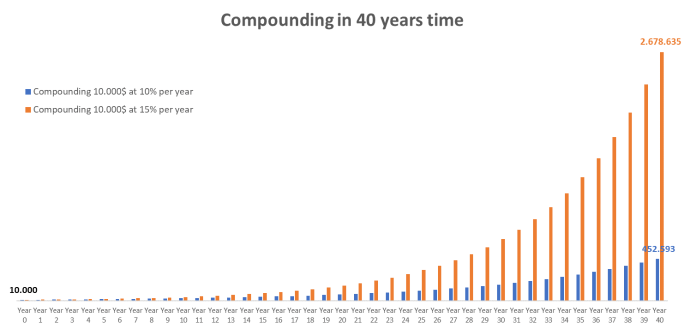
You can therefore easily calculate that the 10.000$ have become around 452.000$: that’s the power of compounding! The money has increased by a 45x factor.

If you are able to reach a higher percentage return, much better. Much much better.
If you can have your investment grow at 15% yearly instead of 10%, after 40 years you will see an increase of your money of about 268x times. Yes, the numbers are correct: if you allow 10.000$ to compound for 40 years at 15% then your investment will be worth 2.678.635$.

Now tell me: isn’t it worth investing well for your old age?